Project Overview

VAE for Alzheimer's

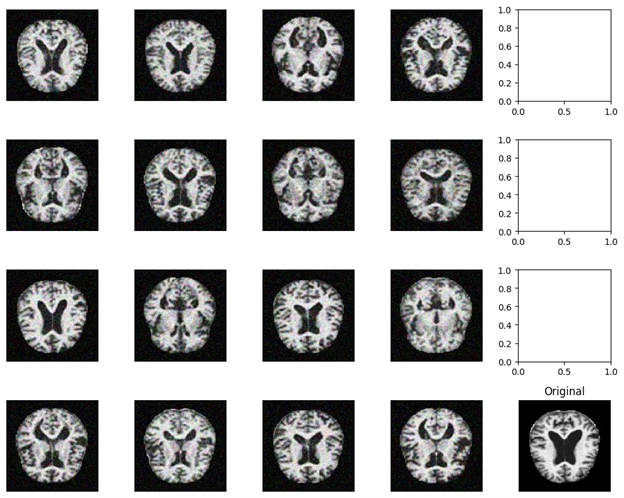
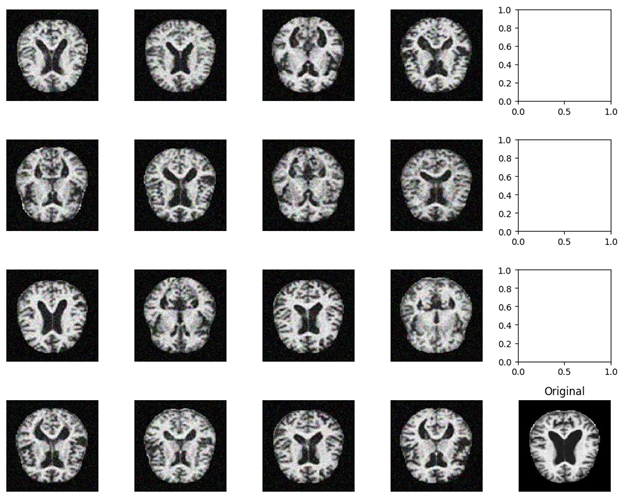
Synthetic data generation for rare Alzheimer's stages.
The Challenge

Understanding the Problem

Alzheimer’s disease research is limited by small, imbalanced MRI datasets, which hinder the training of robust diagnostic models. Manual data collection is costly and time-consuming. Our VAE solution generates high-quality synthetic MRI images, augmenting datasets to improve model accuracy and support early Alzheimer’s diagnosis.
VAE for Alzheimer's - project challenge
Our Solution

From Challenge to Solution

A streamlined process using variational autoencoders to generate synthetic MRI data, enabling robust training of Alzheimer’s diagnostic models.

How We Built It

The Technical Approach

Input MRI Data The VAE takes real MRI scans from Alzheimer’s datasets, preprocessed to standardize dimensions and normalize intensities for consistent input. Latent Space Encoding The encoder compresses MRI data into a latent space, capturing key features of Alzheimer’s-related brain patterns using a probabilistic distribution. Synthetic Data Generation The decoder samples from the latent space to generate realistic synthetic MRI images, preserving pathological features for Alzheimer’s diagnosis. Model Training Enhancement Synthetic data augments training datasets, improving the performance of downstream diagnostic models with up to 15% higher accuracy in validation tests.

Built With

Technology Stack

Python
LangChain
OpenAI
LlamaIndex
scikit-learn
pandas
NumPy
MLflow
Kubeflow
Python
LangChain
OpenAI
LlamaIndex
scikit-learn
pandas
NumPy
MLflow
Kubeflow
More From Us

Related Projects

Explore more of the work we've delivered across different challenges and industries.
Have a Similar Challenge?

Let's Build the Right Solution.

Tell us what you're trying to solve. We'll work with you to turn the challenge into a practical solution.